
That is the whole definition. Getting a number you can trust is harder, because each side of the sum hides decisions: what a house is worth, which debts count, what to do with money held in another currency. This guide works through them in order, with a worked example and the balance sheet of Monverdo's demo household. Make those decisions once and write them down. Then the number means the same thing every time you work it out.
The equation behind the number
Net worth = total assets − total liabilities.[1]
Assets are what you own. Liabilities are what you owe. Accountants call the difference equity: what is left for you once every debt is settled.[2] In a household, equity, net worth and "what you're worth" are the same figure.
Over a year, the equation becomes a movement: closing net worth = opening net worth + what you kept from your income + changes in the value of what you own and owe. Keep that second line in mind. It explains why net worth can rise in a year when you saved nothing. It can also fall in a year when you saved hard.
How to calculate yours in five steps
Pick a date. Net worth is a figure on one day, so every value you use should be on that day. The last day of a month is easiest, because many statements end there.
List what you own, at what it would fetch on that date. Bank balances and savings. Investments and pension savings at their latest value. Your home and any other property at your own fair estimate. Cars and other things you could sell. Money other people owe you.
List what you owe on the same date. The balance on each home loan, not the original amount. Car finance. Card balances, including the ones you clear every month. Student loans. Money you owe to family or friends. Tax you owe but have not yet paid.
Use one currency. If you hold money in another currency, convert it at the exchange rate on that date and write down the rate you used.
Take what you owe from what you own. That is your net worth.
The sum, worked for one household
Here is the sum for an illustrative household, in bare amounts so the arithmetic works in any currency.
| An illustrative household, in bare amounts | |
| What they own | |
|---|---|
| Bank and savings (4,600, plus 12,000 in another currency at 0.80 = 9,600) | 14,200 |
| Investments and pensions | 86,500 |
| Home, at a fair estimate | 410,000 |
| Car | 12,000 |
| Money a relative owes them | 1,500 |
| What they own | 524,200 |
| What they owe | |
| Home loan balance | 268,000 |
| Car finance | 7,800 |
| Card balances | 1,900 |
| Student loan | 9,300 |
| What they owe | 287,000 |
| Own minus owe | |
| Net worth | 237,200 |
Bare amounts: the arithmetic is the same in any currency.
They own 524,200 and owe 287,000, so their net worth is 237,200. Two lines show the steps that trip people up. The bank and savings line includes 12,000 held in another currency, converted at 0.80 to give 9,600. And the 1,500 a relative owes them is something they own, so it counts on the asset side.
Notice what is not on the list: next month's salary, a bonus you have been promised, the pension a future employer might pay in, the inheritance someone has mentioned. Net worth counts what exists on the date, not what might arrive.
When there is more to add up
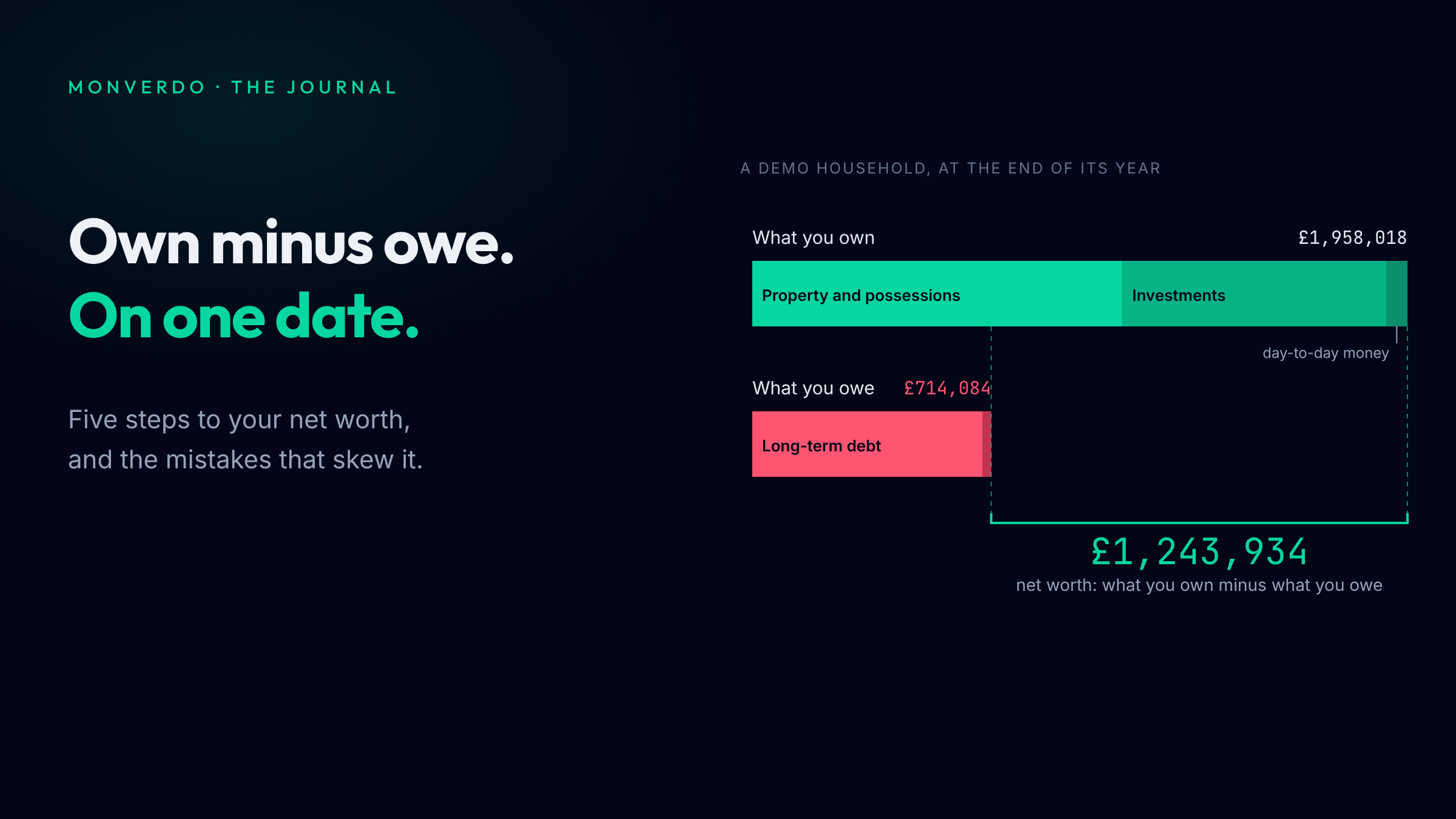
A household with more going on carries more accounts than the example and more judgement. Monverdo's demo household is two working adults and two grown-up children, with a home and its loan, a flat they let out, a second flat abroad, cars on finance, pensions, investments and money in several currencies. Their books run in Monverdo. This is their balance sheet at the end of their last financial year, in five lines, grouped the way the product groups it.
| What you own | |
|---|---|
| Day-to-day money | £63,753 |
| Investments and wealth | £788,157 |
| Property and possessions | £1,106,108 |
| What you own | £1,958,018 |
| What you owe | |
| Short-term debt | £25,592 |
| Long-term debt | £688,492 |
| What you owe | £714,084 |
| Own minus owe | |
| Net worth | £1,243,934 |
Reported in pounds and held in five currencies; each amount in another currency is at the rate on the day it was recorded. Whole pounds; the lines add to the totals shown. They own about 2.7 times what they owe. Property and possessions are more than half of what they own. Over the year, net worth rose 9.4%.
For a household like this one, step 4 carries the most weight: 31.2% of what they are worth is held in four currencies other than the one they report in. Which rate you use for that money, and from which source, moves the total by thousands. Decide it once, write it down and use it every time. A change in the total then means a change in the household rather than a change of method.
Six mistakes that skew the number
Counting a home at what you paid for it. Use what it would fetch now and say that it is your estimate. Use the same method every time.
Counting a loan at its original amount, when what counts is the balance you still owe on the date.
Leaving out small debts. A card balance or an overdraft changes the answer, even if it is cleared next week.
Counting the same money twice. Money moving between two of your own accounts on the date can appear in both. Count it once.
Adding amounts in different currencies without converting them. Convert first, at one date's rate, then add.
Forgetting money owed to you. A loan to a family member is something you own, for as long as you expect it back.
Pensions, the home and other judgement calls
Pensions count. They are yours, even if you cannot reach them yet. A pension that will pay you an income, rather than one with a balance, has no figure to read: use a cash-out or transfer value if the scheme gives one, or leave it out and note that you did. Money an employer has paid in that is not yet yours does not count. Some people work out a second figure without them, or without the home, to see what they could reach in a hurry. That figure is sometimes called liquid net worth. It is a useful second number beside the first, never a replacement for it.
Cars, art and collections count at what they would sell for. For a car that is usually less than it cost, though not always for art or a collection, which can be worth more. If you cannot put a fair value on something, leave it out and note that you did.
Tax you owe counts as a debt. Tax you might owe one day, if you sold something at a gain or drew a pension, is a judgement call. Whatever you decide, decide it once and keep it.
When the answer is negative
A negative net worth means you owe more than you own. It often happens at two stages of life: early on, when a student loan is the largest thing on the sheet; and just after buying a home, when the buying costs have used up the savings and the loan is close to the price.
A negative figure is a starting point. It is also the number that most rewards being tracked, because every month you spend less than you bring in moves it up. Direction tells you more than the sign: a negative net worth that shrinks every quarter belongs to a household getting stronger, while a positive one that slips every year belongs to a household that needs to know why.
What moves the number
Net worth changes for two kinds of reason. The first is what you keep: income after spending, interest, fees and tax. The second is changes in value: markets, your own estimate of a house or a car, the exchange rate. Nobody banks those until something is sold.
A household that can separate the two can tell a disciplined year from a lucky one, because a rise from markets can reverse before anything is sold while a rise from what you kept is already in hand.
How often you work it out is your call. Monthly shows a trend; quarterly catches the larger moves. Consistency counts for more than frequency: the same date in the month and the same way of valuing each thing.
Keep the number without redoing the sum
Most people who work out their net worth do it once in a spreadsheet and stop when the sums get fiddly. Monverdo is built to keep your balance sheet from your own records, so the figure is the bottom line of books that add up rather than a total you rebuild by hand. Every amount is recorded twice, once where it came from and once where it went. An entry that doesn't balance is never saved. Any figure opens to the entries behind it, adding to exactly that figure. The net worth you check next quarter is worked out the same way as this one, so the change between them means something.
Further reading
A fictional demo household. Figures are for illustration, and product screens are concepts.
Monverdo measures and reports on your own figures. It does not give financial advice. Nothing on this site tells you what to buy, sell or do.
Sources
AccountingTools, "Net worth definition", accountingtools.com/articles/net-worth (accessed 20 Oct 2026): "The net worth for an individual is total assets minus total liabilities."
IFRS Foundation, Conceptual Framework for Financial Reporting (2018), paragraph 4.63: equity is the residual interest in the assets of the entity after deducting all its liabilities. ifrs.org (accessed 20 Oct 2026).